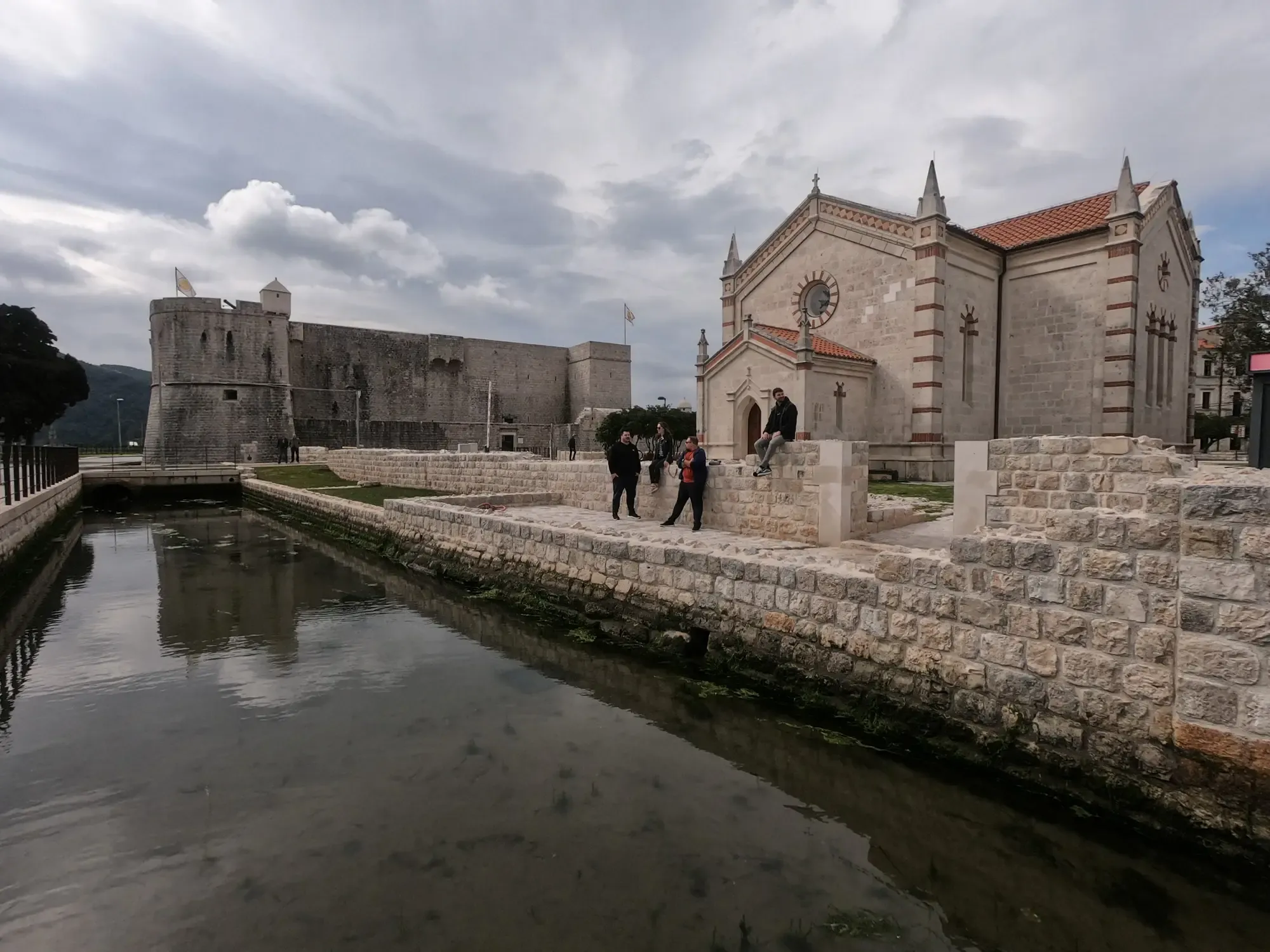
In 1333 the Dubrovnik Republic purchased the Pelješac peninsula from the Serbian Empire in exchange for an annual tribute and a series of payments. The acquisition brought the Republic control of the peninsula's narrowest point, where it joined the mainland, and of the saltworks that sat at the base of the bay. Ston immediately became the Republic's second city — second in administrative importance, second in investment, second in strategic weight, after Dubrovnik itself. The Republic built two towns on the site: Veliki Ston on the southern side of the ridge, adjacent to the salt flats and the bay, and Mali Ston on the northern side, overlooking a separate inlet. Both were laid out on a planned orthogonal grid — at the time, Ston was only the second town in Europe to be designed on a grid plan, after Dubrovnik itself. Walls were set to run along the ridge between them.
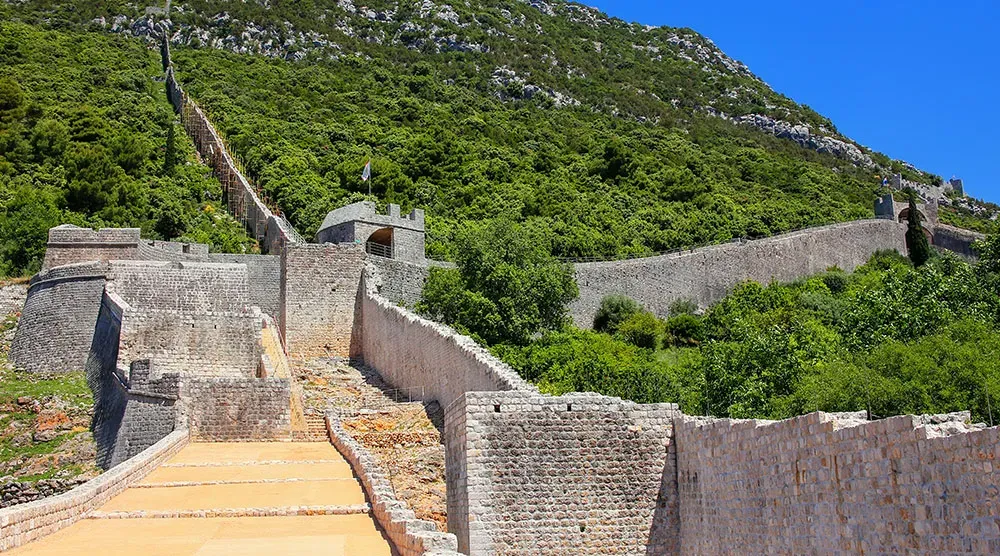
Construction of the walls began in 1358. It continued through the fourteenth and fifteenth centuries, and a Latin inscription on the Field Gate of Veliki Ston, dated 1506, confirms that work was still being commissioned one hundred and fifty years after the project began. The original system exceeded seven kilometres; about one and a half kilometres were demolished in the nineteenth and twentieth centuries to accommodate roads. What remains — 5.5 kilometres of limestone walls, forty towers and five fortresses — is the longest preserved fortification system in Europe and the second longest in the world after the Great Wall of China. Locally the walls are called the 'European Great Wall', a comparison that sounds excessive until you walk them. The full circuit from Veliki Ston to Mali Ston and back via the ridge involves roughly a hundred and fifty metres of elevation gain and takes between an hour and a half and two hours.
The walls were built for the salt. The Ston saltworks are the oldest continuously operating salt works in Europe — their first written record dates to 167 BC, under Roman rule, and production has continued without interruption for over two thousand years. Under the Dubrovnik Republic, salt was the primary commodity: it was collected at Ston and exported through Bosnia to the Balkan interior, and by the nineteenth century as far as Vienna, Prague and Paris. At the Republic's peak, the Ston saltworks produced around five hundred tonnes annually and contributed roughly a third of Dubrovnik's total revenue. The Republic called it 'bijelo zlato' — white gold — and the walls were, at their most fundamental, the mechanism by which that gold was kept. The same traditional hand-harvest method is still used today.
A visitor walking the walls today looks out across those same salt pans — still white, still worked — and over the rooftops of Veliki Ston to Mali Ston Bay beyond. That bay is a special marine reserve with grade-A water quality, one of the last places in Europe where the sea meets that standard, and the only place on the continent where oysters can legally be eaten directly from the water. The European flat oyster (*Ostrea edulis*) farmed here received an EU Protected Designation of Origin in 2020 — Croatia's first PDO for any seafood product. The salt and the oysters are not museum exhibits. Both industries are still running on the same water and the same methods, in the shadow of walls that were built to protect the first one.