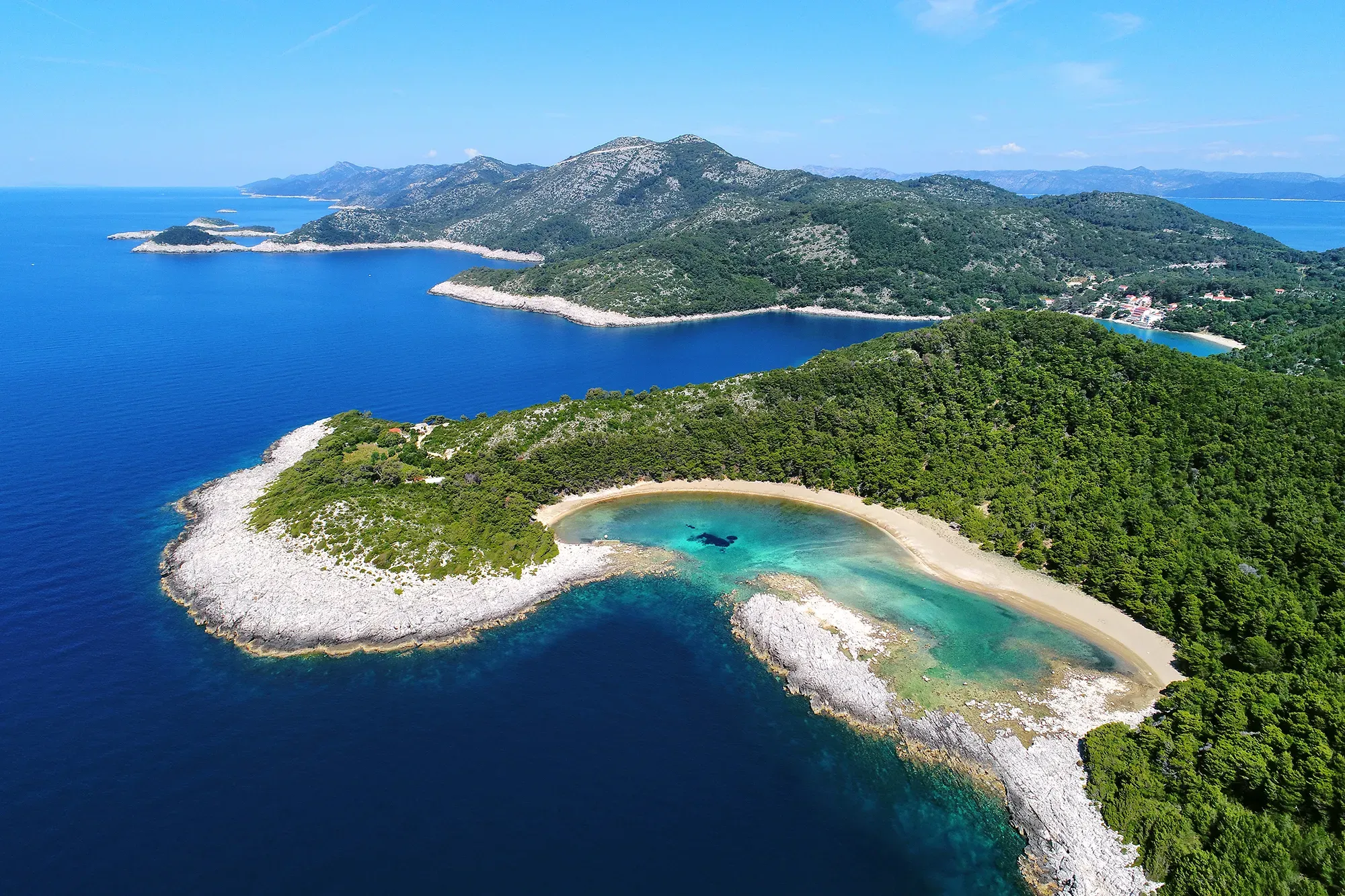
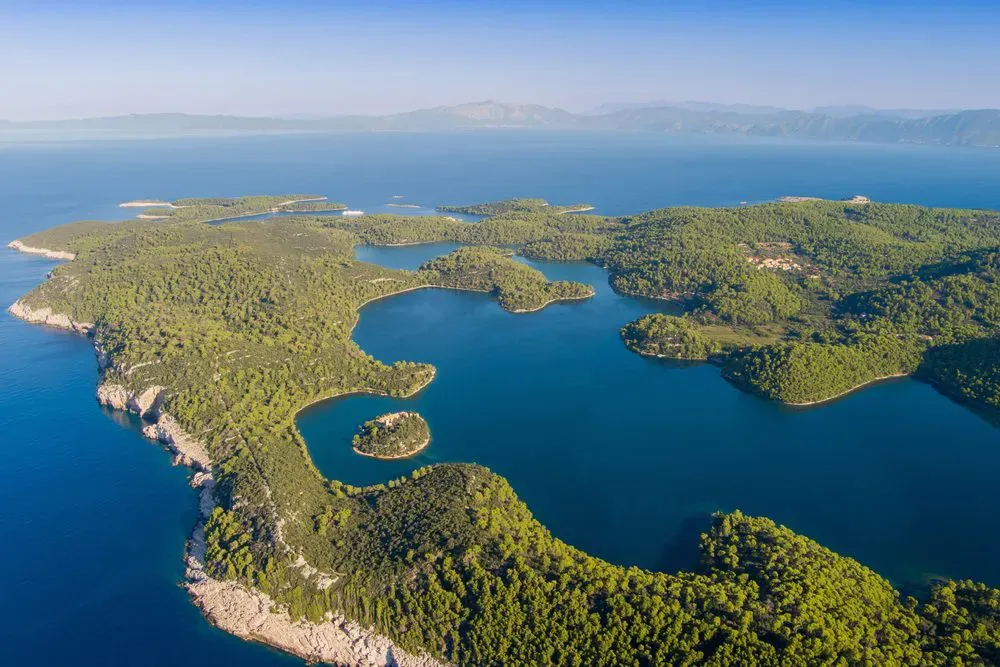
The bay is known locally as Blaca; the beach inside it is called Limuni — which is simply the Croatian word for lemons, translated directly into the English name Lemon Lagoon. It sits at the very eastern tip of Mljet, a short distance around the headland from Mala Saplunara and about fifteen to twenty minutes on foot from the village. What sets it apart from every other bay on the island is a low rocky reef that runs across the mouth of the bay at an angle, leaving only a gap of roughly eight metres through which the sea passes. The bay is not a true enclosed lagoon, but it is close enough that boats cannot enter — the water inside is too shallow to navigate — and the visual impression from outside the barrier, looking through that narrow opening at a stretch of pale sand and pine forest beyond, is unlike anything else on the Mljet coastline. The boat anchors outside. Guests reach the beach by swimming through the gap, or by dinghy.
The restricted exchange between the interior and the open sea has a measurable effect on the water temperature. The lagoon heats faster than the open Adriatic and cools more slowly — on a warm day in May or early June, when the sea outside is still fresh, the water inside can already be comfortable for swimming. Later in the season, in July and August, the difference is less dramatic but still present. The floor is sandy throughout, which keeps the water clear, and the depth stays shallow across most of the lagoon. There are no facilities of any kind on the beach — no kiosk, no hire equipment, no shade structures. The pine forest behind the sand provides natural cover, and everything else comes from the boat.
The local etymology is uncertain. Croatian limuni means lemons, and the village of Saplunara nearby has a reputation for lemon and pomegranate trees, so the connection is plausible, but not formally documented. The bay's other name, Blaca, is the established topographical term used on maps. Both names circulate, and both are correct depending on whether you are referring to the whole bay or the beach inside it. For guests arriving by private boat the practical situation is straightforward: the skipper knows the anchorage outside the barrier, the passage is visible and navigable by swimmers, and the beach on the other side holds roughly four hundred metres of sand with a dense pine canopy behind it. It is, most days, very quiet.