Skip to content
Korčula Town
Marco Polo's Town

Korčula Town

The 'little Dubrovnik' of the central Adriatic

~50 km · ~90 min by speedboat
Private speedboat only
Best time May – October
Typical visit 2 – 4 hours on land
From Dubrovnik ~90 min by speedboat
Highlight Marco Polo House · Moreška
The Story

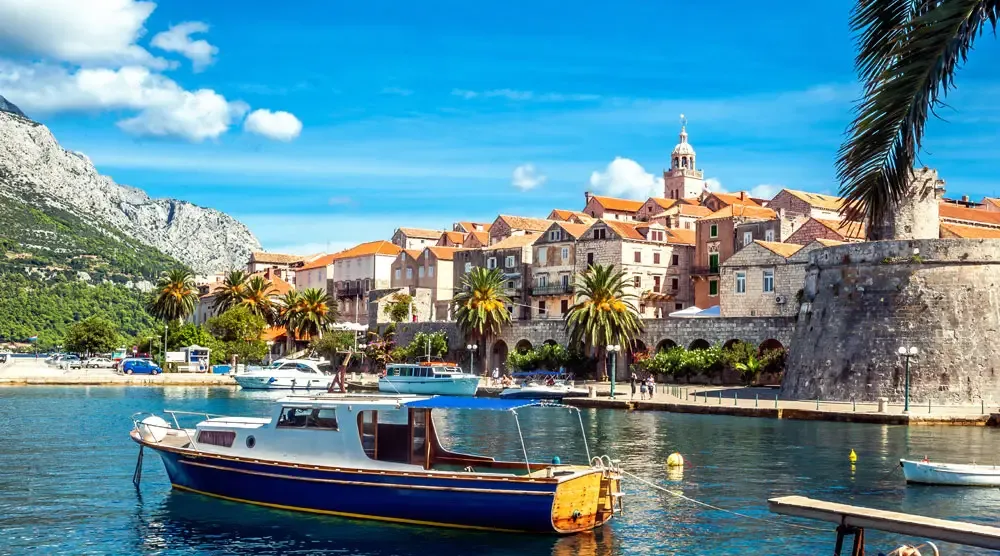
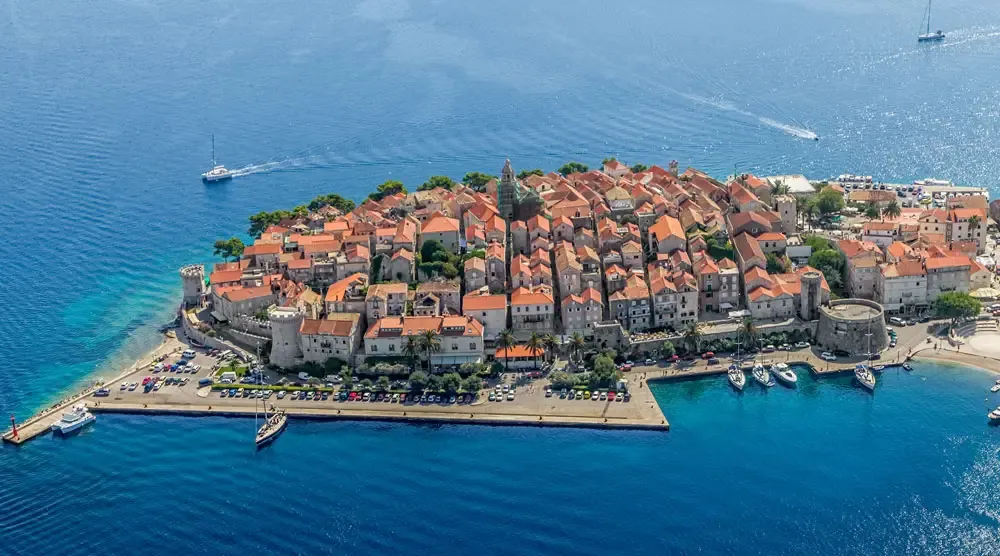
Korčula sits in the central Adriatic, on a small wooded peninsula on the north-east coast of the island that shares its name. From the sea it appears almost as a single architectural object — a tight cluster of stone houses, towers and a single bell tower rising directly from the water, all of it enclosed by Venetian walls. The town was first mentioned in the 10th century by the Byzantine emperor Constantine Porphyrogennetos, but its golden age came under four centuries of Venetian rule, which left the place looking almost exactly as a wealthy Renaissance trading port should.

The first thing you notice walking in is the street layout. Korčula's narrow alleys radiate from a central spine like the bones of a fish — the so-called herringbone pattern — designed to let cool sea breezes through the town while breaking the force of the maestral wind in summer and the bura in winter. With one exception, every street inside the walls is stepped; only the 'Street of Thoughts' along the south-eastern wall is level. Building outside the walls was forbidden until the 18th century, and the wooden drawbridge into town wasn't replaced until 1863.

At the centre of it all stands the Cathedral of St. Mark, built between 1301 and 1806 in a slow blend of Romanesque and Gothic with a fantastical carved façade. Inside are a marble altar attributed to Jacopo Tintoretto and a bell tower with one of the widest views of the southern Dalmatian islands. Around it lie a 15th-century Franciscan monastery with a Venetian Gothic cloister, the palaces of merchant noble families from the 1400s and 1500s, the old Venetian governor's residence — and, on a corner of the main square, the modest stone tower that local tradition identifies as the family home of Marco Polo, the 13th-century explorer who connected Europe to the Far East.

Korčula is also one of Croatia's most surprising wine destinations. The island's centre is the cradle of Pošip, a fragrant golden-white wine first cultivated near the villages of Čara and Smokvica. South of town, in the sandy vineyards of Lumbarda, grows Grk — a rare salt-touched white that is produced commercially nowhere else in the world. Add the centuries-old Moreška sword dance, first recorded here in 1666 and still performed in full costume through the summer months, and Korčula becomes a town you can spend a full day in without seeing it all.
The Experience

What you'll find here

Cathedral of St. Mark

The cathedral that took five centuries to finish (1301–1806) anchors the centre of the old town with its carved Romanesque-Gothic façade and a marble altar attributed to Jacopo Tintoretto. The bell tower is worth the climb for one of the widest views of the central Adriatic.

Marco Polo's house

On a quiet corner of the old town stands a slim Gothic tower-house traditionally identified as Marco Polo's birthplace around 1254. The house is now a small museum about the explorer, his journey to the court of Kublai Khan and Korčula's medieval connections to the wider Mediterranean world.

Pošip & Grk wines

Korčula is the cradle of Pošip — first grown near Čara and Smokvica — and the only place in the world that commercially produces Grk, a rare salt-touched white from the sandy vineyards of Lumbarda. Many of the old-town taverns pour both straight from the producers.

Moreška sword dance

A centuries-old sword dance between the White and Black Kings, performed in full costume to live music. The oldest record of the Moreška in Korčula dates from 1666, and it is now a protected cultural heritage of Croatia — staged regularly through the summer months.

Highlights
  • Marco Polo's family home & museum
  • Cathedral of St. Mark — Renaissance carvings
  • Unique herringbone street layout
  • Pošip & Grk — Korčula's white wines
Gallery
Good to know
  • Wear comfortable, grippy shoes — every street inside the walls is stepped or polished limestone, slippery in the rain.
  • The bell tower of St. Mark is well worth the climb; tickets are bought at the cathedral entrance.
  • Moreška sword dance performances run on Thursday evenings in July and August — worth timing the day to catch one.
  • For lunch, look beyond the marina-side terraces — the small konobas tucked into the back lanes pour the same wines for noticeably less.
FAQ

Questions guests ask

How long does it take to reach Korčula by speedboat?

Around 90 minutes of sailing each way from Dubrovnik in fair weather. Our full-day Korčula tour leaves at 09:00, takes the scenic route along Pelješac with swim stops at Marčuleti and Žuljana, and is back in port by early evening.

Did Marco Polo really come from Korčula?

By long-standing local tradition, yes — the explorer is widely regarded as having been born here around 1254, and the small Gothic tower-house attributed to his family is now a museum. Historians elsewhere link him to Venice, but Korčula's claim is the older and more romantic of the two.

How much time do we need on land?

Two hours is enough for a slow walk around the walls, the cathedral and the Marco Polo house. Three to four hours adds time for a long lunch with a glass of Pošip and a climb up the bell tower.

Is there much beyond the old town to see?

Plenty — Lumbarda's Grk vineyards are ten minutes south, the Moreška sword dance plays through summer, and our full-day route also stops at Marčuleti and Žuljana beaches for swimming and snorkelling on the way out and back.

Experience it

Visit Korčula Town

Private speedboat tours from Dubrovnik that include a stop at Korčula Town.