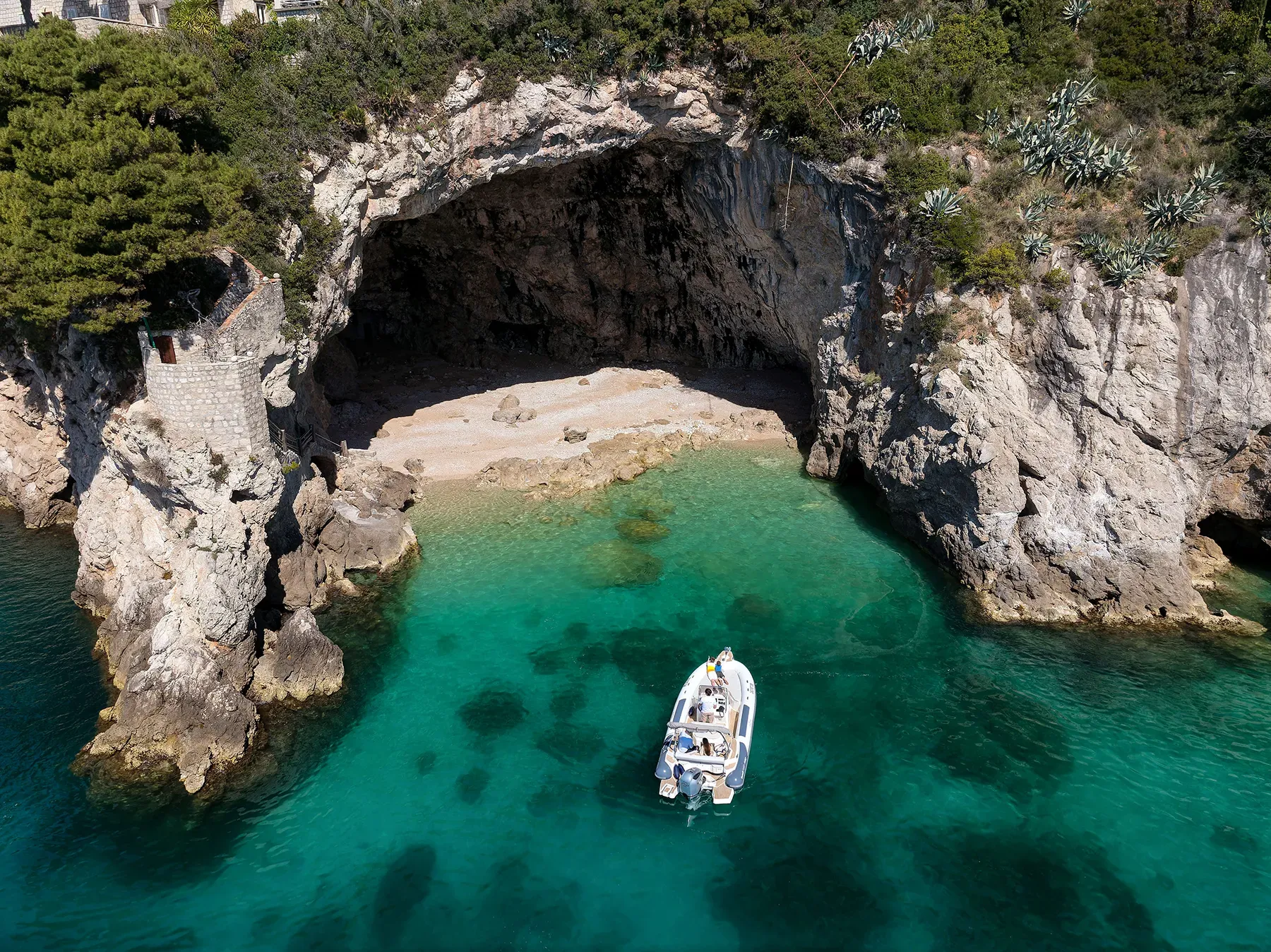
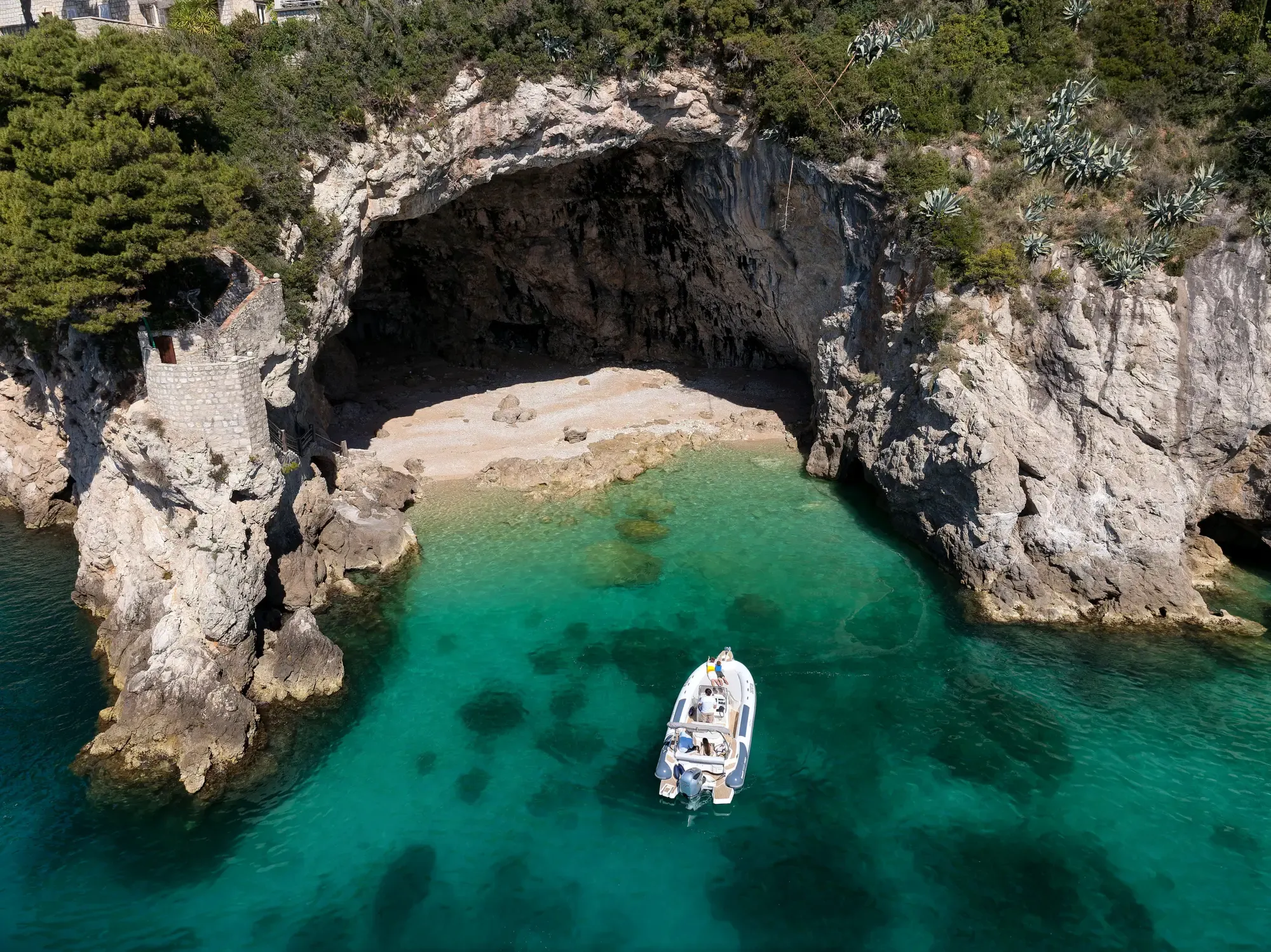
The cave sits in the Ploče district, on the stretch of mainland coast between Villa Sheherezada and Gjivovići beach. From the sea there is almost nothing to suggest it is there — a break in the cliff face, a glint of pale limestone, and then the chamber opens up onto a floor of white and grey pebbles. The cliffs on either side are sheer and unclimbed, which is exactly why the cove has stayed unchanged for centuries.
The name 'Betina' is a shortening of 'Bete', the nickname of Marin Getaldić (1568–1626) — a Dubrovnik mathematician and physicist who used the cave on his family estate as a workshop for experiments with parabolic mirrors. His fellow citizens, watching bright reflections sweep the harbour from a place they could not reach, decided he was a sorcerer setting fire to ships at sea. The reputation stuck, the nickname stuck, and four centuries later the cave still carries his name.
What the cave offers today is what it offered in Getaldić's time: seclusion, still water and remarkable light. In the morning, sunlight enters at a low angle and scatters off the pale pebble floor, filling the interior with an aquamarine glow that the open Adriatic outside never produces. By early afternoon the cliffs cut off the sun and the chamber settles into cooler shadow. Vogue Paris listed the cave among the eight most beautiful beaches in Croatia in 2020.